
Tiebreak drama at 2025 FIDE World Cup in Goa: Niemann and Oro eliminated
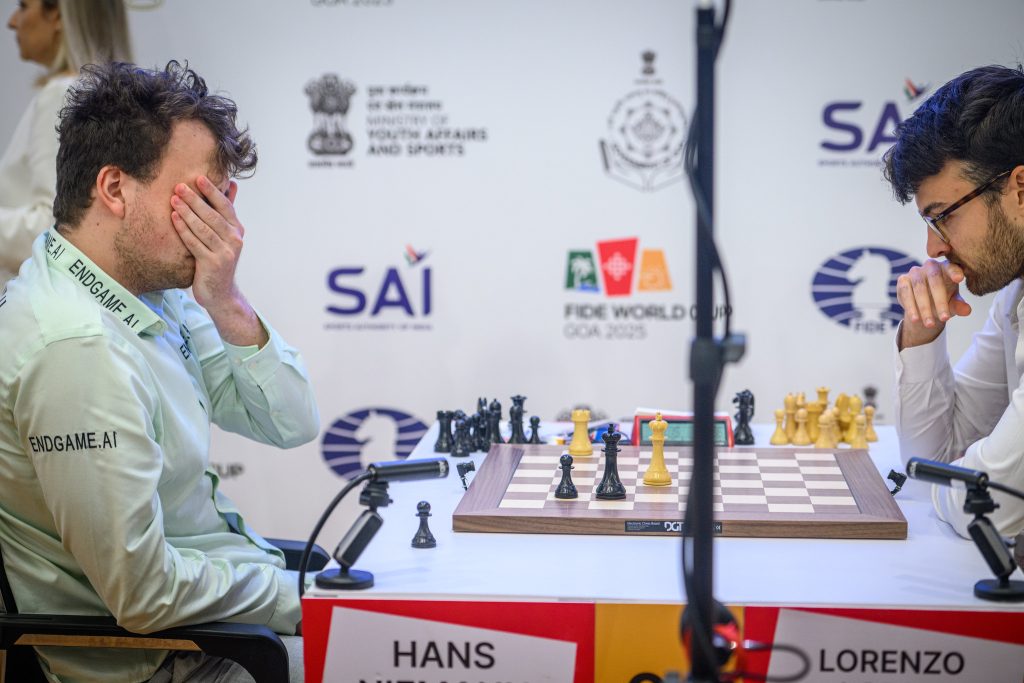
When the best player in the world – former World Champion and 2023 World Cup winner Magnus Carlsen – decides to set everything aside and join the live broadcast, you know the tiebreaks are going to be massive. And they didn’t disappoint! Favourites fell, prodigies stumbled, and the round delivered everything a chess fan could wish for: seven matches going all the way to blitz and even one Armageddon decider. The atmosphere in Goa was electric. Even Ian Nepomniachtchi’s mild post-elimination complaints on Telegram after Round Two were quickly forgotten when another top player addressed the issue directly. “The conditions are fine here,” said Vidit Gujrathi, who had just eliminated Argentine prodigy Faustino Oro. “You can always get a few complaints when you organize a big tournament. He could have been more specific, but I think people are being too harsh on him. Maybe he just lost and said something emotional – I’ll give him the benefit of the doubt. But regarding the conditions, I don’t see any reason to complain.” The Round 2 tiebreaks were officially opened by Mahesh Candolkar, President of the Goa Chess Federation, and Dr. V. Candavelou, Chief Secretary of Goa, who performed the ceremonial first move on Board 1. Rapid 15/10 The shock of the first rapid session came from the elimination of GM Hans Moke Niemann (2738). The American 10th seed was defeated by Italy’s GM Lorenzo Lodici (2560), who held him to two classical draws before winning the first of the two 15-minute rapid games in what was arguably one of the day’s key moments. Lodici seized a decisive advantage earlier, but Niemann appeared to believe he could still draw. Short on time, Niemann blundered with 72…Rg1? – just one square too far! The sequence 73.f6 Rf1 74.Be3! was the point as Black had no Rg1+. After 74…Rf3 75.h7+ Kh8 76.f7 the deal was sealed, 1-0. The only move for Black was 72…Rg2! Compared to the line above after 73.f6 Rf2! 74.Be3 (Bc1) he has the saving check 74…Rg2+. Visibly frustrated, Niemann took some time alone to review the lines on his phone before leaving the venue. Meanwhile, Faustino Oro’s dream run came to an end against Vidit Gujrathi, who prevailed in the first set of rapid games. “I was a bit worried going into tiebreaks — Faustino is very good, and I hadn’t played much rapid lately,” said Vidit. “I tried my best, prepared well, and it worked out.” FIDE’s Charlize van Zyl interviewed Vidit after the match — don’t miss the video! https://youtu.be/ANF6L47_S7k After the match, Oro reflected to this author: “I fell behind on the clock in the second game and couldn’t recover.” Despite his disappointment, he left Goa with valuable experience and a growing fan base. Meanwhile, Nodirbek Abdusattorov, Shakhriyar Mamedyarov, Stamatis Kourkoulos-Arditis (pictured below), Sam Sevian, Daniel Darhda, Bogdan-Daniel Deac, Radoslaw Wojtaszek, Vladislav Artemiev, Pranesh M, Pranav V, Robert Hovhannisyan and Shamsiddin Vokhidov all won their matches at this stage, qualifying for Round 3. Rapid 10/10 The second set of rapid games (10 minutes + 10 seconds) proved even tougher: only three of the ten undecided matches were resolved. GMs Gabriel Sargissian (2611) and Shant Sargsyan (2664) both advanced after long, evenly matched fights against Maxim Rodshtein (2611) and Jorge Cori (2601) respectively. Former World Rapid Champion GM Daniil Dubov (2674) also moved on, defeating GM Jinshi Bai (2595). The Chinese player had neutralized Dubov’s advantages through four games, but a critical error in the Exchange Slav. 12…g4? – cost him dearly. After 13.Bh4! gxf3 14.Bxf3, Bai’s knight on h5 was doomed, and Dubov converted comfortably. Blitz 5/3 Seven matches came down to blitz (5 minutes + 3 seconds). The most dramatic included GM Praggnanandhaa R (2771) overcoming GM Temur Kuybokarov (2535) after falling behind and levelling the score in the first rapid set. In the decisive blitz game, Kuybokarov reached an overwhelming position, but first failed to find a couple winning continuations and then missed a draw. After 37.b6! cxb6 38. Rc1 White’s c-pawn is simply unstoppable. Temur, however, played 37.Rd7? Kf7 38.Bxe7?? (White was still winning after the precise 38.Bd4!) 38…Rxe7. Here Kuybokarov missed a simple defensive resource 39.Rd4, playing 39.Re1?? instead. After 39…Rxd7 40.cxd7 Rxh4+! 41.Kg2 Rd4, the Australian GM was forced to resign – a heartbreaking end to an excellent match. Elsewhere, GM Nikita Vitiugov (2654) bowed out to GM S. Narayanan (2617), who won both 5/3 games after six straight draws in the classical and rapid portions. Blitz 3/2 Two matches went to the final blitz stage (3 minutes + 2 seconds). As expected, the veterans’ clash between GM Ivan Cheparinov (2626) and GM Michael Adams (2635) lived up to its billing. In a show of precision and stamina, Adams won both games, advancing to Round 3 – another deep run in his illustrious career. Armageddon The last and most dramatic tiebreak saw GM Rauf Mamedov (2655) face GM Rasmus Svane (2614). Under the new bidding system for the Armageddon decider, Mamedov bid 3:00, while Svane chose 3:13, thereby securing White. “We were both struggling with the black pieces, me even more than him, so I bid slightly higher to ensure White,” Svane later explained. The decision paid off. Svane converted a slightly better endgame into victory — one of the biggest wins of his career. Looking ahead Sixty-four players remain as Round 3 begins. With three Candidates spots at stake, every match is critical. The field is wide open – and if the tiebreaks were any indication, the coming rounds promise even more spectacular battles. The full pairings for Round 3 matches can be found here [HERE]. Game One of Round 3 will be played on November 7 at 3 PM local time. The action can be followed live on the FIDE YouTube Channel, featuring expert commentary by GMs Evgenij Miroshnichenko and Jan Gustafsson. To watch the games in person, tickets can be purchased [HERE] Written by IM Michael Rahal Photos: Michal Walusza and Eteri Kublashvili
Round 2 Day 2: Gukesh and Erigaisi advance, Wesley and Nepomniachtchi go home
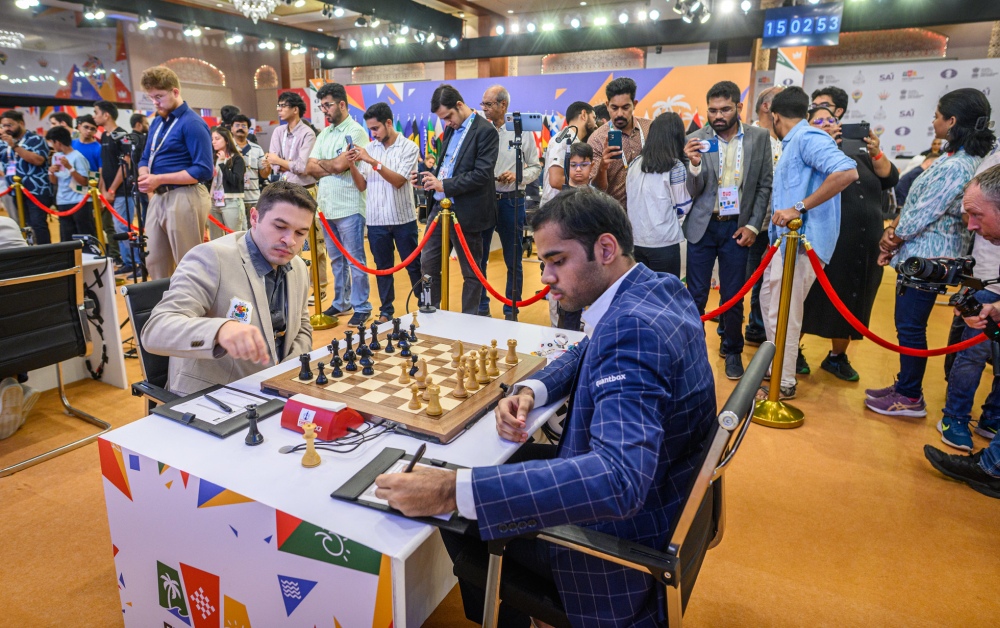
The second game delivered all the drama chess fans could hope for — successes, upsets, nerves, and suspense in equal measure. Leading the headlines was World Champion Gukesh D., who once again demonstrated impeccable form. Playing with Black, he convincingly overpowered Kazybek Nogerbek to secure his place in the third round. Moments later, Gukesh was greeted by hundreds of cheering fans waiting outside the playing hall — a testament to his growing global appeal and India’s passionate chess following. https://youtu.be/3ZCVOl7ZMrI Joining him in the winners’ column were several other top favourites, including Arjun Erigaisi, Anish Giri, Wei Yi, and Vincent Keymer, all of whom delivered commanding performances to advance without the need for tiebreaks. However, not every top seed found smooth sailing. R. Praggnanandhaa, Nodirbek Abdusattorov, Shakhriyar Mamedyarov, and Hans Niemann were unable to finish off their opponents in the classical portion and will have to return tomorrow for what promises to be an intense day of rapid and blitz tiebreaks. Perhaps the biggest disappointment experienced Ian Nepomniachtchi, the two-time World Championship challenger, who suffered an early and unexpected exit. It was a stunning upset and one of the defining stories of the day. Another dramatic twist of the day came from Wesley So, whose premature exit shocked many. Facing Titas Stremavicius, an opponent rated more than 200 points lower, So found himself in a tense endgame while playing with the Black pieces. Under mounting time pressure, he resigned in what was actually a drawn position, overlooking a remarkable stalemate resource that would have saved the game. Other well-known names — including Ray Robson, Vassily Ivanchuk, David Navara, and Johan-Sebastian Christiansen — also bowed out of the competition, their World Cup dreams now on hold until the next edition in two years’ time. Let’s take a closer look at the action as the round unfolded. Inside the calm before the storm: Moments before Round 2 I usually arrive at the playing venue about twenty minutes before the start of each round. There’s something special about those quiet moments before the clocks begin to tick — the soft hum of concentration, the rustle of scoresheets, and the faint click of pieces being placed just so. While most grandmasters prefer to walk in during the last five minutes, a handful of players arrive early, savouring their own pre-game routines. At this level, arriving late is almost unheard of — not only would it bring a hefty fine, but it could even mean losing by forfeit. Among the early arrivals today were GMs Wesley So, Pranav V, Maksimovic, Lodici, and Yu Yangyi — each calmly settling in, preparing scoresheets, and collecting their thoughts for the battles ahead. A clash of generations: Vidit vs. Oro One of the earliest to take his seat was 12-year-old IM Faustino Oro, Argentina’s young prodigy. Oro, meticulous to the last detail, spent several minutes ensuring that each of his pieces sat perfectly centered on its square — a ritual of precision that mirrors his play. His opponent, India’s top GM Vidit Gujrathi, also arrived early, greeted the youngster warmly, adjusted his pieces, and then slipped into his familiar pre-game meditation: eyes closed, steady breathing, complete focus. Vidit enjoyed some extra encouragement today from his mother, who attended the round in a beautiful chess-themed sari, a touching symbol of support. Laughter, focus, and generations united Also among the early arrivals were elite grandmasters Anish Giri and Hans Moke Niemann. Rather than settling into their seats, the two shared a light-hearted moment, trading jokes and smiles in a brief escape from the tension that was soon to come. Their relaxed camaraderie offered a glimpse of the human side of competition — rivals on the board, but colleagues in a shared craft. A few boards away, GM Felix Blohberger exchanged greetings with his good friend GM Thai Dai Van Nguyen before slipping in his noise-cancelling earplugs — a now-familiar ritual that has become his signature. Away from the board, Blohberger is a rising figure in the online chess community: a respected ChessTuber whose thoughtful daily recaps give fans a unique window into the life and mindset of a professional player. Among the most respected presences in the playing hall was GM Shakhriyar Mamedyarov, a world-class competitor for over two decades and now a mentor to some of the brightest young talents in the game. One of his current protégés, 14-year-old Turkish GM Yağız Kaan Erdoğmuş, is also competing in this World Cup. The two arrived together, exchanged a few final words over opening ideas, and wished each other luck before heading to their respective boards — a quiet, meaningful moment that beautifully embodied the connection between chess’s great traditions and its promising future. The enigmatic legend: Vassily Ivanchuk Grandmaster Vassily Ivanchuk is a true legend of the chess world. Arguably one of the most experienced players in World Cup history — having competed in eight editions by most counts — “Chuki,” as he’s affectionately known, remains as unpredictable and captivating as ever. True to his unique rhythm, Ivanchuk typically arrives at the venue well before the round begins, but rather than sitting down immediately, he prefers to wander calmly along the side aisles, hands clasped behind his back, lost in thought. Perhaps this gentle ritual helps him settle his nerves and tune his mind for what lies ahead — another intense four- or five-hour battle over the board. As the final seconds ticked down and arbiters prepared to start the clocks, the atmosphere shifted — quiet intensity filling every corner of the hall. The calm before the storm was over. The games had begun. The ceremonial opening of the round As per tradition, Łukasz Turlej, the FIDE Secretary General, made the symbolic first move on board three — the game between GM R. Praggnanandhaa (from Chennai, India) and GM Temur Kuybokarov (representing Australia). The ceremonial event also hosted Santosh Sukhadeve, IAS, who is the Sports Secretary for the Government of Goa, as the government representative for
Round 2 Game 1: Gukesh debuts, Aronian and Wei Yi shine, Faustino continues to amaze
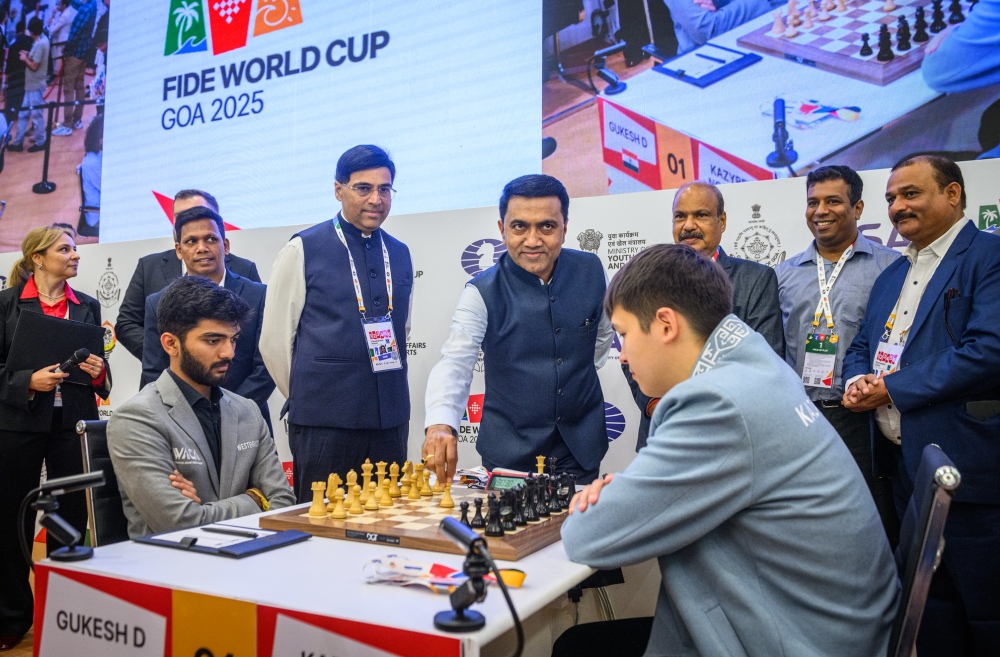
It was a huge day for Goa’s chess scene. The top fifty seeds, including World Champion Gukesh D, debuted this afternoon in the Baga Resort Rio playing hall, joining the seventy-eight qualifiers from the opening round. To honour the occasion, the state’s Chief Minister Dr. Pramod Sawant, accompanied by five-time former World Champion and FIDE Deputy President Vishy Anand, opened the round by performing the ceremonial first move on Gukesh’s board. Unfortunately for the number one seed, luck was not on his side this time. His opponent, GM Kazybek Nogerbek (2543) from Kazakhstan, held the draw with the Black pieces — not a result many can boast against the reigning World Champion. Before play began, both Anand and the Chief Minister attended a packed press conference. When asked for his top picks to win the event, Anand—as usual—was cautious, but he did point out that GM Levon Aronian “has already been enjoying Goa for the last week, so it’s quite clear that he is taking the event very seriously.” A fan’s perspective Before being a player or an announcer, I am, above all, a chess fan. One of the great perks of working as a FIDE press officer is the chance to walk around the playing area and watch, up close, the games of the best players in the world. Leaving aside Magnus Carlsen, Hikaru Nakamura, Fabiano Caruana, and Alireza Firouzja, who for one reason or another decided to skip the event, practically all the world’s top 100 are here. It’s a true who’s who of elite chess, and I don’t take for granted the privilege of being here to witness it all. Having covered chess for some time, there are only a handful of players I haven’t yet seen live. One of them is the American star Hans Moke Niemann — and he’s definitely taller than I imagined! It will be fascinating to see how he performs in his first World Cup appearance. Esipenko’s sparkling attack As expected at this level, most games ended in draws — I suspect many matches will go to tiebreaks. Still, a few players notched up early wins, mostly with the White pieces. The first decisive result came about two and a half hours into the session, when GM Andrey Esipenko (2693)defeated 2023 Baku World Cup semi-finalist GM Nijat Abasov (2587) in a dominant attacking display. Abasov had just played 17…Be7–d6, defending the pawn on e5. Esipenko thought for five minutes and unleashed a bolt from the blue: 18.Ba6!, threatening checkmate on b7. The bishop can’t be captured due to mate on a8, but Esipenko still had to calculate several defensive tries. Abasov responded with 18…c6, blocking the diagonal, but after 19.b5!, the attack became irresistible. The key variation: 19…bxa6 20.bxc6! Qc7 21.Qf5+ and White wins. In the game, 19…c5 20.b6! sealed Abasov’s fate, and he resigned a few moves later. Wei Yi strikes in style Among the later games, GM Wei Yi (2753)’s encounter with GM Kacper Piorun (2557) caught my attention. The Chinese prodigy—now a university graduate—has fully returned to professional chess, bringing back his trademark aggressive style. After 17…Bxe3, Piorun may have expected 18.Qxe3, aiming for simplification after 18…Qxe6 19.f4 Qb6! Instead, Wei Yi stunned with 18.Bf7+!! Kxf7 (18…Qxf7? 19.Qxe5+) 19.fxe3, pinning the queen and winning decisive material. In his postgame chat, Wei Yi said: “My opponent played the opening in a romantic style, like a puzzle. I haven’t been to India many times, but I really enjoy Goa. I think I prefer blitz and rapid formats, though—I spend too much time in classical games!” https://youtu.be/TNc_7BhYfdQ Aronian’s beach vibes and brilliant finish A World Cup wouldn’t be complete without GM Levon Aronian (2728). A two-time winner — Khanty-Mansiysk 2005 (vs. Ponomariov) and Tbilisi 2017 (vs. Ding Liren) — Aronian is a master of knockout formats. In Goa, he started strongly, defeating Bengali IM Aronyal Ghosh (2520), in an attacking masterpiece that featured a sparkling piece sacrifice. Black had an extra piece but a shattered kingside and an out-of-play queen. Aronian’s finish was vintage brilliance: 25.Rg4+! Nxg4 26.Qxg4+ Kh8 27.Qd4+! f6 28.Qd2!, the key move, after which Black resigned. One pretty line runs: 28…Kh7 29.Re7+ Kg6 30.Qd3+ f5 31.Qxg3+ Kh5 32.Bd1 mate! Other highlights Other 2700+ favourites also began well, including Arjun Erigaisi (2773), Vincent Keymer (2755), Shakhriyar Mamedyarov (2742), Maxime Vachier-Lagrave (2737), Richard Rapport (2724), Javokhir Sindarov (2721), Vladimir Fedoseev (2720), and the newest member of the 2700+ club, Awonder Liang (2710). Liang’s opponent, Max Warmerdam, reached an equal position in a complicated Ruy Lopez battle but made the wrong choice at the critical moment. Black had to decide which pawn to take—f2 or b2? After the correct 37…Rxb2! 38.f6 Qxf6, White has to force a draw by perpetual check: 39.Rxf8+ Kxf8 40.Qc8+ Ke7 41.Qc7+ Ke6 42.Qc8+ Kd6 43.Qc6+. Instead, Warmerdam captured the “wrong” pawn with 37…Rxf2??, which failed to 38.f6! g6 (alas, 38…Qxf6 does not work anymore, as after 39.Rxf8+ Kxf8 40.Qc8+ Ke7 41.Qc5+, White wins the f2-rook) 39.Qg5!, threatening Qh6. Black had to give up the exchange with 39…Rxf3 and was checkmated on move 60. Among relatively surprising results include: Ivan Zemlyanskii (2596) defeated Ray Robson (2664). Georg Meier (2596) took down Volodar Murzin (2664), the reigning World Rapid Champion, with Black. But remember — it’s a two-game match, and anything can happen tomorrow. Finally, 12-year-old Argentine prodigy Faustino Oro continues to impress, holding elite Indian GM Vidit Santosh Gujrathi (2716) to a draw with Black from the position of strength. Looking ahead Round one of the Goa World Cup has set the stage for thrilling tiebreaks and surprises. With the stars in attendance, the beaches buzzing, and the boards on fire, the chess world will be watching Goa very closely in the coming days. Game 2 of Round 2 begins on November 5 at 3 PM local time. The action can be followed live on the FIDE YouTube Channel, featuring expert commentary by GMs Evgenij Miroshnichenko and Jan Gustafsson. To watch the games in person, tickets can be purchased [HERE] Written
12-year-old IM Faustino Oro steals the show in Goa tiebreaks
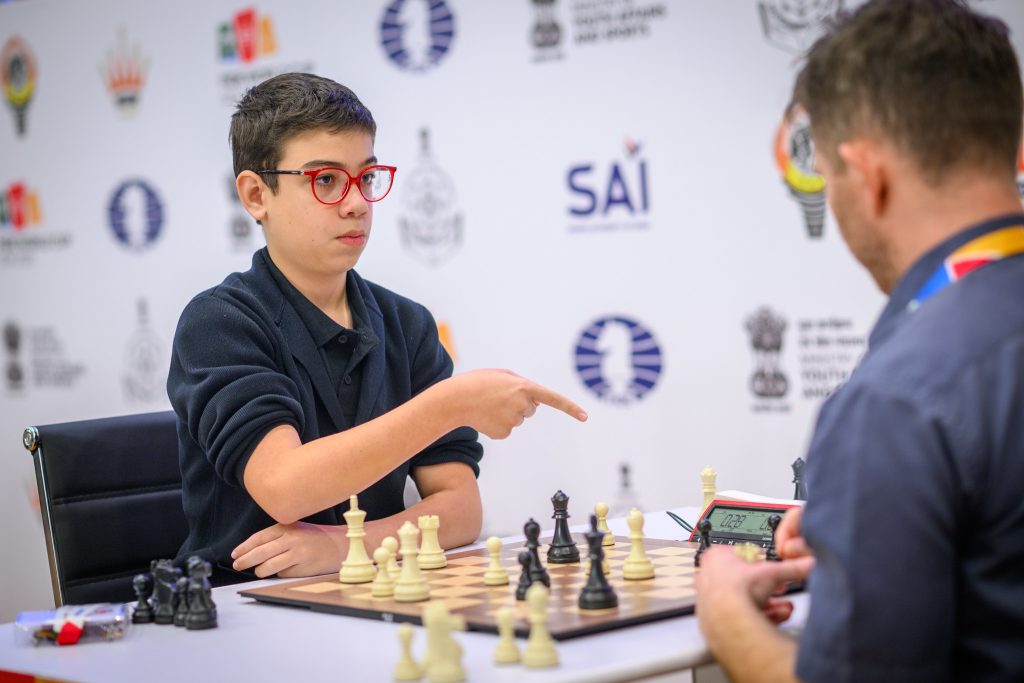
The nerve of the tiebreaks Blitz and rapid tiebreakers are nerve-racking spectacles. In rapid games, players have enough time to think, plan, and avoid blunders, yet must still manage their time carefully. It’s a delicate balance between classical depth and blitz speed. Blitz, on the other hand, is fast, intuitive, and electric — a format where players rely on instinct, pattern recognition, and split-second calculation. Common online and in casual play, blitz demands confidence, courage, and above all, emotional control under pressure. Few embody these qualities better than 12-year-old Argentinian IM Faustino Oro. The prodigious talent, already known for online victories against Magnus Carlsen and Hikaru Nakamura, showed maturity beyond his years by defeating seasoned GM Ante Brkic in Goa today. The round was ceremonially opened by Sanjiv M. Gadkar IAS, Secretary Protocol, Government of Goa, on Board One, where GM Robert Hovhannisyan faced FM Kavin Mohan. For tomorrow’s all-important second round, the Chief Minister of Goa is expected to make the honorary first move for World Champion Gukesh D. Rapid rounds: Surprises and systems Out of twenty matches, fourteen were decided within the first two rapid games — overturning many pre-round predictions. Most rating favourites advanced, though not all without a fight: six matches ended 2-0, and eight concluded 1.5-0.5. A noticeable difference from the classical portion was the choice of openings. Many players opted for flexible “systems” such as the Colle, London, and Anti-Sicilian setups — less theoretical but highly dynamic, well-suited to faster time controls and reduced defensive resources. With these results, Round 2 is set. All fifty seeds have arrived, ready to enter the action tomorrow afternoon — a round that promises fireworks and fascinating matchups. Let’s look at this afternoon’s action in more depth. The early qualifiers The first player to qualify under the 15+10 rapid section was GM Sunilduth Lyna Narayanan (2617). The strong Kerala Grandmaster, currently ranked India’s number seventeen, defeated IM Steven Rojas Salas (2413) of Peru by a clean 2-0. A 52-move grind with Black in the first game left Rojas Salas struggling, and Narayanan finished him off in style with a 22-move miniature in the second, capitalizing on a major blunder. According to Theophilus Wait, Lichess Operations Director present in Goa, Narayanan warmed up for the day with over fifty bullet games online: “I play a lot of bullet — that’s one of my ways to get in shape. I play fast and check a bunch of lines with the computer later.” It seems the routine paid off handsomely. Other clear 2-0 victories included: GM Jorge Cori (2601, Peru) defeating IM Aldiyar Ansat (2470, Kazakhstan). GM Temur Kuybokarov (2535, Australia) beating GM Jan Subelj (2532, Slovenia) in a match highlighted by a brilliant checkmating finish. Kuybokarov sealed the game with 49…Nh3+ 50.Kh2 Nf2+ 51.Kg1 Rh1+! 52.Kxf2 Qxe3 mate 0-1. GM Tin Jingyao (2583, Singapore) defeating IM Jegor Lashkin (2492, Moldova). GM Ghosh Diptayan (India, 2564) overcoming GM Peng Xiongjian (2520, China) by the same score. IM Bojan Maksimovic (2532, Bosnia) eliminating GM Emre Can (2541, Turkey) — both classical games had been drawn. Narrow escapes and determined youngsters Eight matches ended 1.5-0.5, mostly favouring higher-rated players. Among the standouts was FM Kavin Mohan (Malaysia, born 2011), who drew both classical games against GM Robert Hovhannisyan (2629) before narrowly losing in the rapid portion — a superb showing for the 14-year-old. Elsewhere, GM Alisher Suleymenov (2491, Kazakhstan) defeated GM Arturs Neiksans (2585, Latvia), while GM Denis Makhnev (2525, Kazakhstan) ousted GM Diego Flores (2563, Argentina) winning by the same margin. After his elimination, Neiksans congratulated his opponent and humorously announced his return to the commentary desk: The 10+10 Rapids: One match decided, five headed to blitz Six matches advanced to the second two-game rapid set (10+10). The play was fiercely balanced, with only IM Aronyak Ghosh (2520, India) managing to win both games and advance. His opponent, GM Mateusz Bartel (2575, Poland), fought hard and even gained attacking chances in the final game before a sudden blunder ended his run: Bartel’s 20.Qf3?? allowed 20…Nh4, a double attack that forced immediate resignation. Blitz deciders: Youth and nerves of steel With six games already behind them, players entered the blitz tiebreaks (5+3) — a pure test of energy, nerves, and composure. All five matches were decided at this stage, featuring both upsets and heroic efforts. The headline story came from IM Faustino Oro (Argentina, 12 years old), who won both blitz games to qualify for Round 2. Overjoyed, “Fausti” was whisked off for a fair-play check before returning for a quick post-match chat: “I’m so happy to have qualified. It’s been a very tough match,” he said. “I missed a key tactic in the final game, but luckily for me the position was still tricky.” https://youtu.be/thmg-CpdxU0 Elsewhere, GM Daniil Yuffa (2618, Spain) survived a marathon match against IM Shiyam Thavandiran (Canada, 2400), eventually clinching both blitz games but acknowledging his opponent’s resilience. GM Max Warmerdam (2577, Netherlands) also needed blitz to overcome GM Lalit Babu M R (2506, India), in a match where momentum swung dramatically. Two other tightly contested duels saw GM Kazybek Nogerbek (2538, Kazakhstan) defeat GM Raja Rithvik (2541, India), and GM Ahmed Adly (2589, Egypt) edge past GM Karen Grigoryan (2481, Armenia) — the latter still a formidable competitor and former 2650-rated player. Looking ahead The first day of tiebreaks offered everything — drama, blunders, brilliance, and youthful audacity. With all 50 seeds now entering the fray, Round 2 promises high-voltage encounters as established stars meet fearless challengers. Goa’s World Cup is heating up, and if today’s rapid and blitz battles are any indication, the days ahead will be nothing short of spectacular. Game 1 of Round 2 begins on November 4 at 3 PM local time. The action can be followed live on the FIDE YouTube Channel, featuring expert commentary by GMs Evgenij Miroshnichenko and Jan Gustafsson. To watch the games in person, tickets can be purchased [HERE] Written by IM Michael Rahal Photos:
FIDE World Cup R1 Day 2: Favourites advance, but drama awaits in the tiebreaks
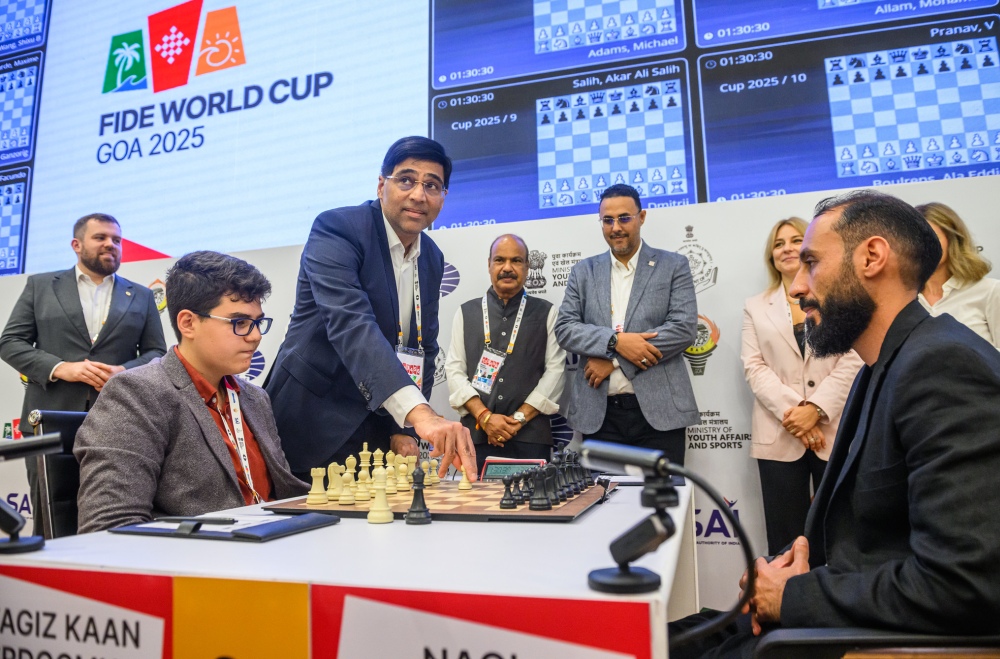
With the gradual arrival of most of the top 50 seeds, the second game of round one commenced on time in the convention hall of the Baga Resort Rio in Goa. Among others, I spotted elite 2700+ GMs Nodirbek Abdusattorov, Shakhriyar Mamedyarov, Javokhir Sindarov, Vladimir Fedoseev, and Jorden van Foreest acclimatising to the new location. I also had the pleasure of having lunch with the 13th seed, Le Quang Liem from Vietnam. Commentator Jan Gustafsson noted that players might need a bit more time to adapt: “Two days seem to be cutting it rather close if you arrive from a distant time zone.” Top Indian Olympiad player Vidit Gujrathi obviously doesn’t have this disadvantage, though he still enjoyed a relaxed stroll around the playing hall toward the end of the round. More top players are expected to arrive throughout the day, with the rest of the field assembling at the venue tomorrow — eager to learn who they will face in the second round of the knockout. All of them, including World Champion Gukesh D., will join the action in round two. The venue welcomed a very special guest to perform the ceremonial first move. Vishy Anand — former five-time World Champion and current FIDE Deputy President — opened the round by playing 1.c4 for Turkey’s Yagiz Kaan Erdogmus on board one. The move was met with 1…e5, played on behalf of his opponent, Abugenda Nagi of Libya, by Mr. Ali Fouzi, President of the Libyan Chess Federation. Just fifteen minutes into the playing session, three players had already secured qualification to the second round. Amin Bassem, Étienne Bacrot, and Nikita Petrov were each awarded victories by forfeit after their opponents failed to appear for their two-game matches. Barbadian International Master Orlando Husbands, however, arrived too late for the first game of his match but eventually made it to the venue and put his opponent — top German Grandmaster Frederik Svane (2640) — to the test. Though he ultimately lost and was eliminated, he fought valiantly and made his presence felt on the board. Over the following hours, the hall was filled with deep concentration. As I moved among the tables in search of the most compelling encounters, the atmosphere was almost tangible — focus at 100%, and the tension of high stakes evident on every face. The first decisive result was confirmed shortly after the midpoint of the round. American 15-year-old prodigy Andy Woodward scored the opening victory of the afternoon, defeating India’s Gusain Himal with a convincing 2–0 overall score. Playing with the black pieces, Woodward had already seized the initiative. With his last move, 19…Ngf4, he attacked the pawn on g2. White needed to eliminate the knight immediately, but after just three minutes of reflection, Gusain blundered with 20.Kf1?, allowing 20…Nxg3+ 21.fxg3 Nh5!, creating the decisive threat of 22…Nxg3, which would win material. The strength of the bishop on a7, dominating all the dark squares around White’s king, became apparent. Recognizing the hopelessness of his position, Gusain resigned soon after. With this victory, Woodward advances to face a formidable opponent in round two — Austria’s Kirill Alekseenko(rated 2679). As more results began to come in, attention turned to one of the most anticipated encounters of the day — the game featuring one of the youngest participants in the tournament, 14-year-old Argentinian prodigy IM Ilan Schnaider (rated 2401), against former European Champion Aleksandar Indjic, a strong Serbian Grandmaster rated 2635 — and, at 6’8″, arguably the tallest GM in the world! Having lost the first game, Schnaider needed a victory to force a tiebreak. After the opening, he had exactly the kind of dynamic position he was hoping for. The Serbian’s king on d7 was in serious trouble in this chaotic position, clearly favorable for White. Schnaider spent nearly fifteen minutes here, weighing his attacking options, before deciding on 17.Nf4, and ended up just slightly better. However, he missed a golden opportunity to press for the full point. Instead the move played, he could have launched a powerful assault with 17.Qa4+! The key idea is after 17…c6 fails to 18.Be7! attacking the queen and preparing dangerous follow-ups such as Qa3–d6 or Re4. It’s likely that a player of Schnaider’s caliber examined this line but dismissed it due to the absence of an immediate tactical breakthrough. Needing only a draw to advance, Indjic chose to simplify the earliest opportunity and calmly secured qualification after a draw in a double-rook endgame. Yesterday’s biggest upset came when Chilean GM Cristóbal Henríquez Villagra unexpectedly lost on time in a theoretically drawn endgame against an opponent rated 150 points lower. Determined to make amends, he struck back today with an impressive attacking victory that forced a tiebreak. Henríquez Villagra concluded the game in style with the precise and elegant 45.Re8+!. The point is simple yet beautiful: after 45…Qxe8, White delivers a classic “Dovetail Mate” with 46.Qd6#. A clean and instructive finish — and a fitting way to erase the memory of yesterday’s disappointment. Combination of the day It’s always difficult to single out the best combination of the day — with so many great games unfolding simultaneously, it’s nearly impossible to keep track of them all. Nevertheless, Spain’s number one, GM David Antón Guijarro, secured his 2–0 qualification to the next round with a brilliant queen sacrifice against Angolan IM David Silva. Silva has just played 31.Rea1, threatening Ra7 and giving up his bishop on g5, in order to seize control of the seventh rank and threaten the f7-pawn. Antón thought for a few minutes before confidently accepting the challenge with 31…Bxg5. After 32.Ra7, he stunned the spectators by sacrificing his queen: 32…Qxa7! 33.Rxa7 Rf6!, attacking White’s queen and turning the tables completely. After 34.Qd1 Rxf2, Silva resigned. A spectacular illustrative line might be 35.h3 Rxf1! 36.Bxf1 Be3+ 37.Kg2 Bxe4+, with a decisive attack. It’s clear that Antón had foreseen this entire sequence before giving up his queen — a testament to both courage and calculation. Meanwhile, the recent Women’s World
World Cup 2025 kicks off in Goa: Anand honored, young stars shine
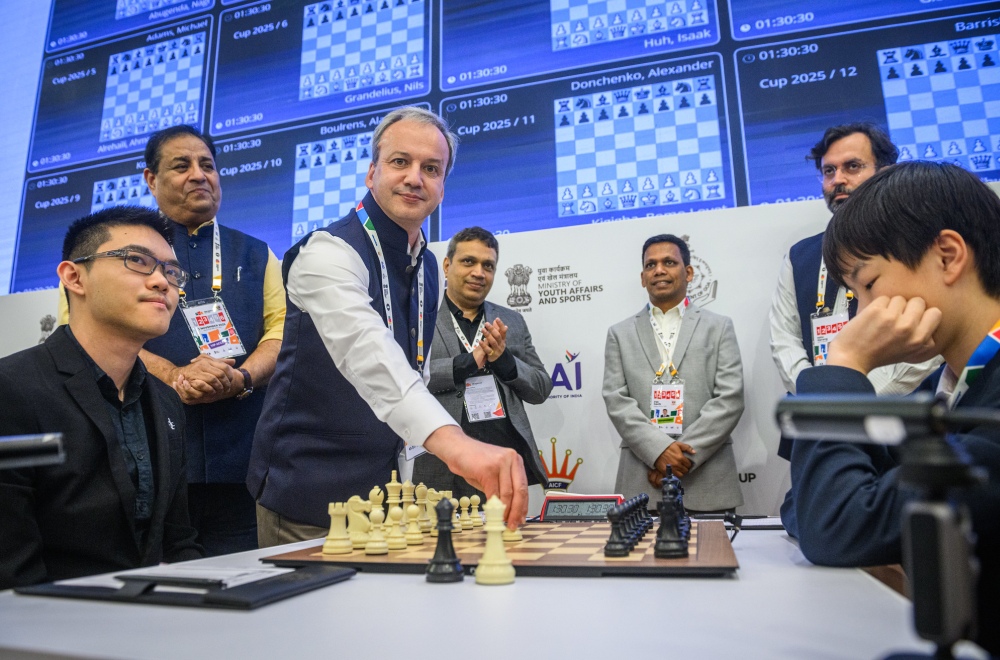
The first game of Round One of the FIDE World Cup began this afternoon at 3:00 PM local time in the Baga Resort Rio’s convention centre in Goa, India. The pristine venue hosted the opening clashes of what promises to be a thrilling month-long event, featuring 206 of the world’s top players battling for three coveted spots in the Candidates Tournament — the final step toward challenging for the World Championship title. The round opened with the traditional ceremonial first move: FIDE President Arkady Dvorkovich played 1.e4 on behalf of GM Jeffery Xiong (USA). AICF President Nitin Narang mirrored the move for GM Pranav V (India). According to tournament regulations, the top 50 seeds are automatically qualify for Round 2, meaning 78 games were contested today. Move of the day One of the first games to conclude in Round 1 featured the sensational Yagiz Kaan Erdogmus, currently rated 2651 and rapidly ascending the world rankings. Born in 2011, the Turkish prodigy is, as of 2025, the youngest grandmaster in the world — and today, he once again demonstrated why. Facing Candidate Master Nagi Abugenda (Libya, 1972), Erdogmus unleashed a brilliant attacking display in an Exchange French Defence. White, already behind in development and with his king stranded in the centre, was caught in the crossfire of a sharp tactical strike. From this moment, Black’s attack erupted with the bold sacrifice 10…Nce5!, forking the queen and bishop. The young grandmaster spent only six minutes calculating the sequence. “I thought this was going to be a long game and that I would win in the endgame,” said Erdogmus afterward. “But then he started to play very aggressively. I think he missed knight e5, and after that he’s just losing.” After 11.dxe5 Nxe5 (another fork), 12.Qxd5 Be6! followed — a developing move that renewed the attack by targeting the overloaded queen. When White retreated with 13.Qe4, Erdogmus continued energetically with 13…f5!, and after 14.Qe3, he had already foreseen the decisive 14…Bd5!, simultaneously attacking the rook on h1 and threatening 15…Nf3+ winning the queen. With no way to parry all the threats, Abugenda resigned a few moves later, conceding victory to the young Turkish star in impressive fashion. On board two, GM Jeffery Xiong (USA, 2648) prevailed in a difficult endgame against CM Li Yiheng (Hong Kong, 1994). Despite the 650-point rating gap, the 12-year-old from Hong Kong played far above his rating, testing the American grandmaster’s technique at every turn. https://youtu.be/u79ZODb5XFQ In his post-game comments, Xiong praised his young opponent’s resilience and talent: “I wasn’t at all surprised because he is a very young player and, as someone who was already giving GMs a tough fight when I was thirteen years old, I knew going in that he was a prodigy and that I should take it very seriously.” On board three, GM Maxim Rodshtein (Israel, 2647) took the lead in his two-game mini-match against CM Qin Oscar Shu Xuan (New Zealand) with a crisp victory as Black. Rodshtein seized the initiative early, gradually building pressure before launching a decisive kingside attack that left his opponent defenceless. Meanwhile, on board five, England’s former world top-ten player GM Michael Adams (2646) showcased his renowned technical precision. In a queen endgame, Adams converted his outside passed pawn into a new queen, sealing a clinical victory in trademark style. Rounding out the top results, GM Vladislav Artemiev (FIDE, 2637) also outplayed CM Heskiel Ndahangwapo of Namibia, trapping his opponent’s queen in the middlegame — a rare tactical motif at this level, and one that drew murmurs of admiration from spectators following the games online. With so many fascinating games on display, it was impossible not to notice several dazzling moments of creativity. One game, in particular, stood out for its sheer precision and ingenuity. In his encounter with IM Satbek Akhmedinov (Kazakhstan, 2372), GM Pranesh M. (India, 2630) found the only move to force victory in a razor-sharp position. In the position, where 47.Bd4+ would have allowed 47…Qxd4, saving the game, and 47.Rf1 would have fallen to 47…Rxg2+!, Pranesh instead uncorked the spectacular 47.Qg7!! Now the twin threats of 48.Bd4+ and 48.Rc6+ loomed, either of which would have decided the game instantly. Akhmedinov tried to resist with 47…Ra1+, but Pranesh calmly blocked with 48.Rf1+!, picking up the rook on a1 and forcing immediate resignation. Outstanding stuff from the young Indian grandmaster. The World Cup’s opening round once again reminded everyone of its trademark unpredictability, as several underdogs punched above their weight to produce surprises and memorable results. The biggest upset of the day came when Chile’s top player, GM Cristóbal Henríquez Villagra (2605), fell with Black in a tricky rook + bishop vs bishop endgame against IM Agibileg Uurtsaikh (Mongolia, 2448). A handful of grandmasters were unable to break through and had to settle for draws — likely saving their energy and preparation for Game 2. Among them: FM Mohan Kavin (Malaysia, 2346), who held GM Robert Hovhannisyan (Armenia, 2633) to a solid draw. IM Reja Neer Manon (Bangladesh, 2369), who split the point with GM Aryan Tari (Norway, 2631). Another standout performance came from FM Daniel Barrish (South Africa, 2284), who pressed with Black throughout against Goa’s own GM Raunak Sadhwani (2641) before agreeing to a draw after 56 moves — a truly impressive result for the young South African. Last but not least, the only female player in the field, recent Women’s World Cup champion GM Divya Deshmukh (India), was defeated by GM Stamatis Kourkoulos-Arditis (Greece, 2583). Divya showed ambition from the start, sacrificing a pawn in the opening to build attacking chances. However, the compensation never fully materialized. As the game steered into a complex double-rook endgame, time pressure took its toll — one misstep was all it took for the Greek grandmaster to seize control and convert the point. Divya will have another opportunity tomorrow to even the match. https://youtu.be/3X6iRvyRrrM Asked afterward about the unusual atmosphere created by dozens of cameras and spectators crowding the top boards, Kourkoulos-Arditis smiled: “I’ve
Opening ceremony of the 2025 FIDE World Cup dazzles in Goa

The Dr. Shyama Prasad Mukherjee Indoor Stadium in Goa hosted this afternoon the 2.5-hour-long opening ceremony of the 2025 FIDE World Cup, marking the official start of one of the world’s most prestigious chess events. A vibrant mix of India’s leading music and film industry artists delighted an audience of over a thousand players, officials, and guests with a series of breathtaking performances interwoven with inspiring speeches from dignitaries and chess leaders. At 4:30 p.m. sharp, the evening’s presenters welcomed everyone to the ceremony, noting that 206 top players from around the world will compete for the USD 2 million prize fund in what promises to be the toughest intellectual battle ever, focused on strategy, determination, and motivation. After the audience stood for the Indian national anthem, the dignitaries performed the traditional lighting of the lamp a symbolic act representing blessings, greatness, and positivity. The distinguished guests included Dr. Mansukh Mandaviya, Union Minister of Youth Affairs and Sports; Dr. Pramod Sawant, Chief Minister of Goa; Dr. Ramesh Tawadkar, Minister for Art & Culture, Tribal Welfare and Sports & Youth Affairs of Goa; FIDE President Mr. Arkady Dvorkovich; and AICF President Mr. Nitin Narang. A curtain-raising video followed, celebrating The Spirit and Story of Chess, and concluding with the stirring line: “Where strategy meets spirit and champions are born.” The Hormuzd Khambata dance company then took the stage with a dazzling performance paying tribute to Goan color and culture. Among the evening’s speeches, two stood out. Mr. Nitin Narang, President of the All India Chess Federation, read a recorded message from Prime Minister Narendra Modi, who expressed his hope that the FIDE World Cup would inspire a new generation of players. He emphasized that “the event offers a special opportunity not only to showcase talent but also to motivate the youth ” and with these words, he declared the FIDE World Cup 2025 open. FIDE President Arkady Dvorkovich followed, reminding everyone that the tournament is among the most important and dramatic in the FIDE calendar. Of the 206 players participating, only three will qualify for the 2026 Candidates Tournament, the gateway to the world championship match. Dvorkovich described Goa as “not just a coastal paradise, but the Colosseum of Chess” where legends are forged and new champions born. He concluded by wishing all players good luck and fair play, adding: “While we cannot yet say who will be the winner in Goa, two things are certain: this will be a great event, and the players will experience the full breadth of Indian hospitality, which is difficult to match.” As Dvorkovich ended his remarks, the audience rose for the FIDE anthem, followed by an energetic live performance of The Spirit of Goa by Hema Sardesai and her band. Then came a special moment: GM Divya Deshmukh, the recent 2025 Women’s World Cup Champion and the only female player in this event, joined the presenters on stage to conduct the drawing of lots. By selecting black for Gukesh, the top seed, it was determined that all odd-numbered players will start their first games with the black pieces. Divya shared her excitement: “Playing on home soil and representing India gives me an extra sense of pride and motivation.” A flute and beatbox performance by the Qudrot Duo followed, before the dignitaries reunited on stage to unveil the Vishwanathan Anand World Cup Trophy – a magnificent brass and gold-plated creation, symbolizing passion, precision, and performance. A final video screening of the official World Cup song – It’s Your Move – preceded the night’s closing performance by the legendary Usha Uthup band, who brought the house down with powerful renditions including Skyfall from the James Bond film of the same name. Round 1 begins on November 1 at 3:00 PM local time. The action can be followed live on the FIDE YouTube Channel, featuring expert commentary by GMs Evgenij Miroshnichenko and Jan Gustafsson. To watch the games in person, tickets can be purchased [HERE] Written by Michael Rahal Photos: Michal Walusza, Eteri Kublashvili
FIDE, AICF and KIIT University Sign Landmark MoU to Promote Chess in Education and Society
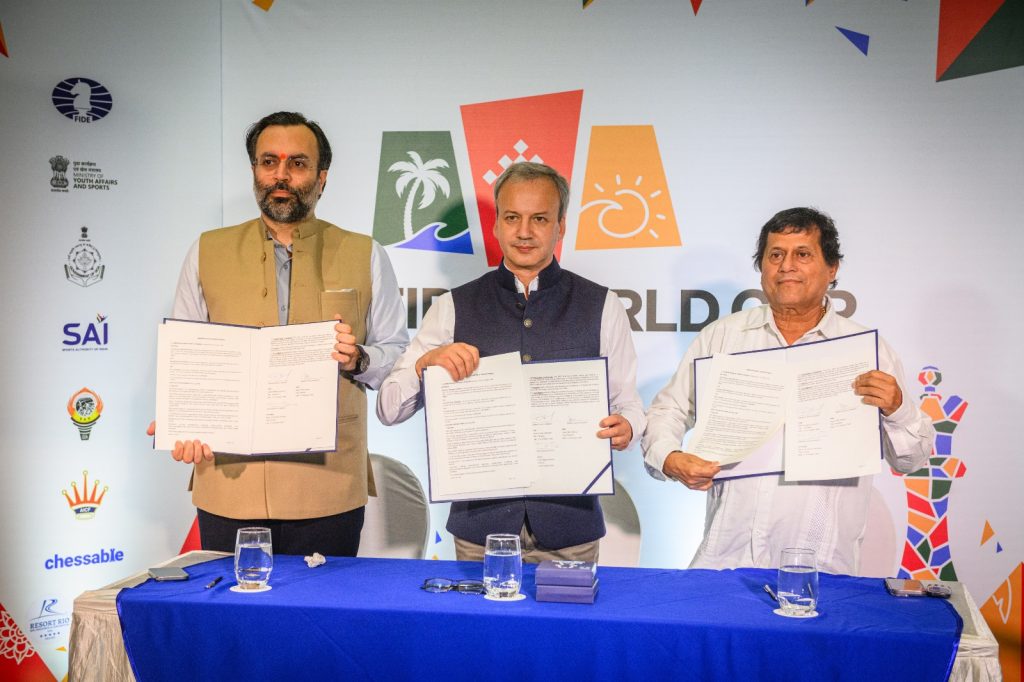
Goa, India — October 31, 2025 A new chapter for chess and education was written this morning at the Hotel Rio Resort in Goa, India, where the International Chess Federation (FIDE), the All India Chess Federation (AICF), and KIIT University officially signed a Memorandum of Understanding (MoU) to promote the values of chess in education and society across India, Asia, and the world. The signing took place just hours before the opening of the 2025 FIDE World Cup, highlighting the shared commitment of all parties to use chess as a tool for learning, inclusion, and personal growth. President Arkady Dvorkovich, representing FIDE; President Nitin Narang, representing the AICF; and Dr. Achyuta Samanta, Founder of KIIT and KISS Universities and Member of Parliament, signed the MoU in a ceremony attended by chess officials, educators, and media representatives. The agreement sets a framework for cooperation through 2025 and 2026, focusing on joint initiatives such as training programs, workshops, conferences, research, case studies, school competitions, and awareness campaigns. The collaboration also aims to enhance teacher training and develop educational programs that bring chess into classrooms and communities — beginning in India and expanding globally. “We have recently launched the 2026 Year of Education in Chess, following this year’s Year of Social Chess. There is an ongoing effort to fulfill the social mission of our beloved game, and we are delighted to find more and more partners joining us in this endeavor. This Memorandum will help us promote chess in schools and share best practices and knowledge—not only in India but globally,” said Arkady Dvorkovich, President of FIDE. “It’s a proud moment to sign this MoU, with India leading the way in Social Chess. I am confident that AICF, KIIT, and FIDE will make every effort to ensure that every school provides access to chess from an early age,” said Nitin Narang, President of AICF. “We are committed to promoting all forms of sports in India, and our chess programs have been running successfully for many years. I warmly invite everyone to the January conference in the beautiful city of Bhubaneswar, and I hope it will be a great success,” said Dr. Achyuta Samanta, Founder of KIIT University. As part of the agreement, an International Conference on Social Chess and Educational Chess will be held in January 2026 in Bhubaneswar, hosted by KIIT University. This event will form part of FIDE’s global initiatives: the Year of Social Chess 2025 and the Year of Educational Chess 2026, bringing together international and Indian experts to explore how chess can foster social inclusion and educational innovation. In closing the ceremony, Arkady Dvorkovich presented KIIT University and the AICF with the Social Chess Years Award Medal, in recognition of their commitment to advancing chess for social good. This landmark collaboration underscores India’s growing leadership in the global chess movement — demonstrating how the game can transform education, empower youth, and connect communities worldwide. About FIDE The International Chess Federation (FIDE) is the governing body of world chess, founded in 1924, with 200 national federations as members. FIDE promotes chess as a tool for education, inclusion, and international cooperation. About AICF The All India Chess Federation (AICF) is the national governing body for chess in India, overseeing the game’s development and organization from grassroots to elite levels across the country. About KIIT University KIIT (Kalinga Institute of Industrial Technology), based in Bhubaneswar, India, is one of the country’s leading universities, renowned for its commitment to inclusive education, innovation, and social impact through its sister institution, KISS (Kalinga Institute of Social Sciences).
Tickets Now on Sale for the FIDE World Cup 2025!

The wait is over! Tickets are now available for the opening rounds of the FIDE Chess World Cup 2025, taking place in Goa, India from 1 to 26 November 2025. You can now book your seats for the first two rounds (1 to 6 November 2025) and witness world-class chess up close. This year’s World Cup brings together 206 of the world’s best players, competing for a $2 million prize fund and three qualification spots in the FIDE Candidates 2026.Among the stars in action are World Champion Gukesh, Arjun Erigaisi, Praggnanandhaa, Nodirbek Abdusattorov, Anish Giri, Vincent Keymer, and many more. Choose Your Experience We’ve designed several ticket options to help you enjoy the World Cup in your own way: Playing Hall Ticket:Step into the arena and experience world-class chess up close. You can choose from four time slots to see the action live, including a special Photo Slot that allows limited photography before play begins. Fan Zone Pass:Join live commentary sessions with India’s top chess voices; IM Tania Sachdev, IM Sagar Shah, GM Harshit Raja, GM Sahaj Grover, Amruta Mokal, and Sahil Tickoo. You’ll get to interact with them throughout the day and even meet players who visit the fan zone after their games. Ticket Costs Classical Game Days (1, 2, 4 & 5 November) Playing Hall Tickets: Photo Slot 1 – ₹500 | 2:00 PM (Photography permitted until 3:10 PM) Slot 2 – ₹300 | 4:15 PM Slot 3 – ₹300 | 5:15 PM Slot 4 – ₹300 | 6:15 PM until end of play Fanzone Ticket: ₹1,000 Full-day access to the Fanzone Playoff Days (3 & 6 November) Full Day Ticket: ₹800 Grants full-day access to the playoff rounds, where every move could decide a player’s World Cup journey. Fanzone Ticket: ₹1,000 Full-day access to the Fanzone Terms and Conditions All ticket purchases are final and non-refundable. Internet handling fees may apply per ticket. Arrive at least 15 minutes before your scheduled time slot. Please do not attend if you feel unwell. Unlawful resale will result in ticket cancellation without refund. Seating is first-come, first-served. Entry to the playing hall is subject to limited capacity. No mobile phones or electronic devices allowed inside (except for Photo Slot 1). Phones must be deposited before entering. Silence must be maintained in the playing hall. Photography is only permitted during Photo Slot 1. Fan Zone Pass grants full-day access. Slot Ticket allows entry only during your chosen time slot Cash-and-carry food counters will be available on-site. The organizer reserves all rights of admission and policy updates. Tickets are limited and selling out quickly, don’t miss your chance to witness the FIDE World Cup 2025 in person. Book your tickets now
Preview: FIDE World Cup 2025 – Goa, India
Two hundred and six of the world’s best chess players from more than 80 countries will descend on Goa, India, this week for the 2025 FIDE World Cup, arguably the most important individual chess event of the year. From October 30 to November 27, players will battle through a gruelling knockout format for a share of the USD 2 million prize fund and, more importantly, the three coveted qualification spots for the 2026 FIDE Candidates Tournament — the gateway to the next World Championship match. “India is not just the ancient home of chess; it is a global modern powerhouse. This World Cup is being held here because India is now a central pillar in the global structure of our sport. For the next four weeks, Goa will not just be a coastal paradise; it will be the Colosseum of Chess. This is where legends are forged and broken, and new champions born – a process that has been dramatically enriched by the incredible new generation of Indian stars,”said Arkady Dvorkovich, FIDE President The structure of the World Cup is unique within elite chess. It’s an eight-round, single-elimination knockout event, where each match consists of two classical games played under standard time controls. If the score is tied after those, the players return on the third day for a series of rapid and blitz tie-breaks to decide who advances. The top 50 seeds — comprising many of the world’s highest-rated grandmasters — receive byes into the second round, while the remaining 156 competitors begin their campaigns on the afternoon of November 1st. All games will take place in the Resort Rio, Goa’s largest convention hall and a five-star luxury venue just moments from Baga Beach, offering a fittingly grand stage for one of the most prestigious tournaments on the chess calendar. “I’m really excited and looking forward to playing in the World Cup. Anywhere in India is great of course, but I have some nice memories of Goa as I played some junior events there,” declared Gukesh D, current World Champion, one of the favourites, seeded straight into round two. For the first time since 2002, the FIDE World Cup returns to Indian soil. On that occasion, Viswanathan Anand, the legend from Chennai, defeated Rustam Kasimdzhanov in the two-game final held in Hyderabad, a victory that helped cement India’s emergence as a major force in world chess. More than two decades later, India hosts the event from a position of unprecedented strength. The country now boasts D. Gukesh, the reigning World Champion; Olympiad team titles in both the Open and Women’s sections; and Divya Deshmukh, the current Women’s World Cup winner and the only female participant in this year’s World Cup. Add to that a remarkable generation of rising stars — Arjun Erigaisi, R. Praggnanandhaa, Nihal Sarin, and others — and India’s chess renaissance will be on full display in Goa. At the top of the starting list stand the three Indian superstars, who will be playing on home soil and must be considered the main favourites for the title. Top seed D. Gukesh arrives in Goa in scintillating form, fresh from a 2927 performance at the European Team Championship, where he won gold on board one and played a decisive role in his team’s overall victory. Arjun Erigaisi, though dropping a few rating points in the same event, has been one of the most consistent elite players this year and will be eager to reaffirm his status among the very best. Meanwhile, R. Praggnanandhaa opted to skip the European Teams altogether, choosing instead to rest and prepare after a demanding Grand Chess Tour final in Brazil, ensuring he comes to Goa fully recharged. Among the international contenders, Germany’s Vincent Keymer stands out as a major threat. Currently world number four on the live rating list, he gained 18 rating points across the European Club Cup and European Team Championship, where he secured silver on board one, just behind Gukesh. Another clear favourite is Anish Giri, the recent Samarkand Grand Swiss winner. In superb form and with his Candidates qualification already secured, Giri enters the World Cup relaxed but motivated — looking to extend his streak after taking bronze at the European Team Championship. “I’m looking forward to playing the World Cup. It’s a great event and a lot of fun. I’ve played a lot of them, and I was actually very near to qualifying once. Although I played very well that year, I still remember losing a semi-final to Peter Svidler. It’s definitely a very tricky qualification path,” Giri said, after winning in Uzbekistan. The American duo of Wesley So and Levon Aronian can never be ruled out in an event of this nature. Wesley So arrives in Goa on the back of a second-place finish at the U.S. Championship, completing an eleven-game unbeaten run. Renowned for his composure and strength in rapid and blitz formats, So’s consistency and knockout experience make him a formidable contender. Levon Aronian, the 2017 World Cup winner, has also enjoyed a resurgent 2025, collecting multiple titles in prestigious events and finishing third — also unbeaten — at the U.S. Championship. Few players in the field can match his combination of creativity, resilience, and experience under pressure. Among other 2700+ players to watch are China’s Wei Yi, India’s Nihal Sarin, and Hungary’s Richard Rapport. All three have delivered impressive performances in recent months, with Wei Yi continuing his steady return to top form, Nihal showing growing maturity and consistency on the elite stage, and Rapport producing dynamic results throughout October. Each will be eager to make a deep run and claim one of the three coveted qualification spots for the 2026 Candidates Tournament. With such a large field, some strong players will begin their campaigns early and face stiff opposition right from Round One, while the top seeds will enter in Round Two. Excelling in classical chess remains essential, but in this knockout format, tie-breaks — rapid and blitz games played under intense